
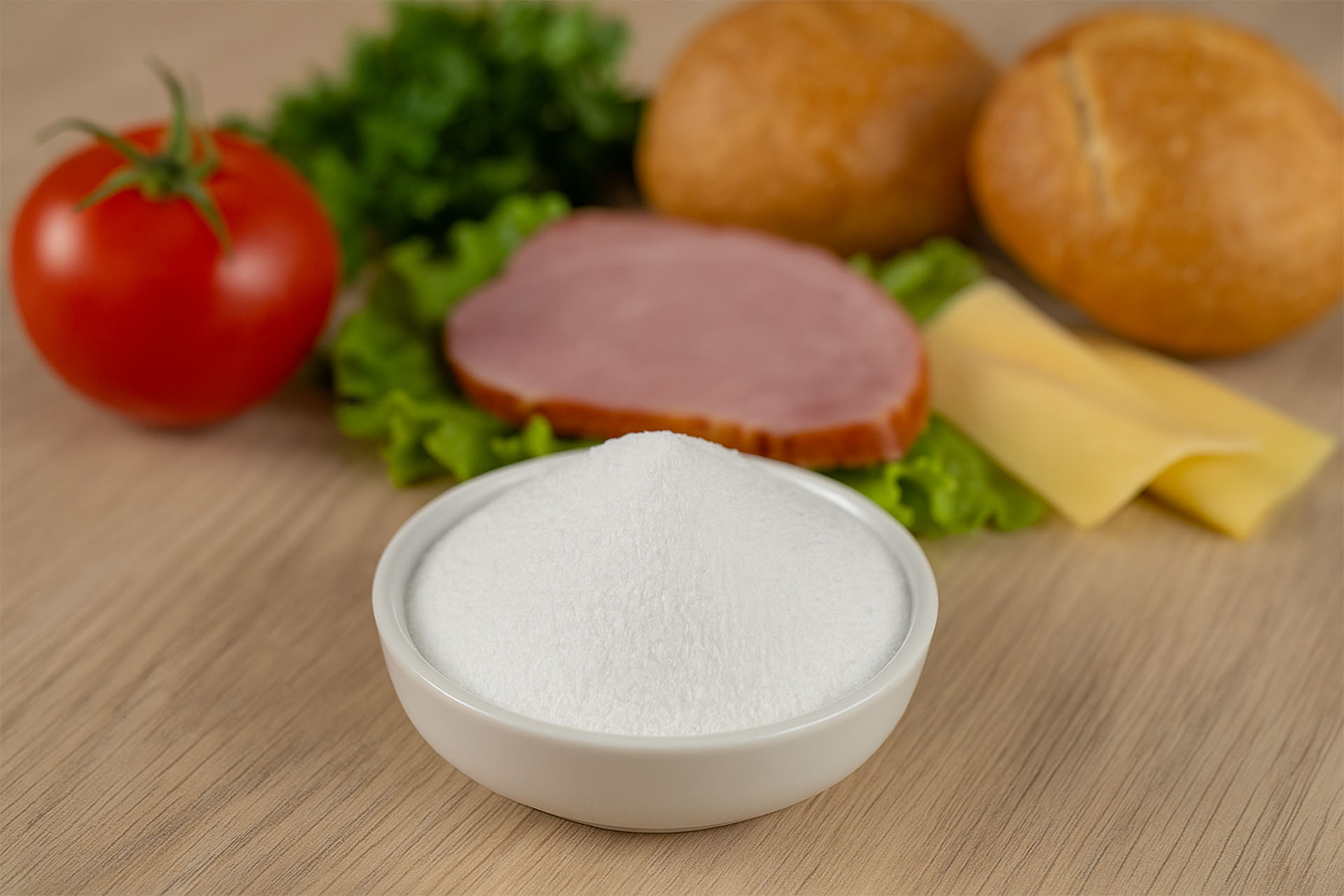
Sodium diacetate, with the chemical formula NaH(C₂H₃O₂)₂, is a complex composed of acetic acid and sodium acetate. As an efficient and safe food additive, it is widely used in the food industry, especially in terms of preservation, mildew prevention and flavor adjustment. Sodium diacetate not only has broad-spectrum antibacterial properties, but also plays a significant role at low concentrations, while meeting food safety standards, so it is widely used worldwide.
1. Chemical properties of sodium diacetate
Sodium diacetate is a white crystalline powder with a slight acetic acid smell. It is easily soluble in water and its aqueous solution is weakly acidic (pH 4.5-5.0). It can slowly release acetic acid (acetic acid) in food, thereby exerting an antibacterial effect. Its chemical structure enables it to have both the high antibacterial properties of free acetic acid and the stability of sodium acetate, giving it a unique advantage in food preservation.
2. Application of sodium diacetate in the food industry
2.1 Baked foods
Sodium diacetate is widely used in baked foods such as bread, cakes, and biscuits. Its main functions are:
Inhibit mold and bacteria and extend shelf life;
Replace traditional preservatives (such as calcium propionate) to reduce unpleasant flavors;
Still maintain high antibacterial effects in low pH environments (such as sourdough bread).
2.2 Meat and poultry products
In processed meat products such as sausages, ham, and bacon, the effects of sodium diacetate include:
Inhibit pathogenic bacteria such as Listeria and Salmonella;
Reduce the use of nitrite and reduce the risk of cancer;
Maintain the color and flavor of meat products.
2.3 Snacks and puffed foods
Snacks such as potato chips, nuts, and popcorn are susceptible to mold contamination. Sodium diacetate can:
Prevent the production of aflatoxin;
Provide a stable preservative effect without high-temperature treatment.
2.4 Condiments and sauces
Condiments such as soy sauce, salad dressing, and ketchup are prone to yeast and mold growth. Sodium diacetate can:
Extend shelf life;
Do not affect the original flavor of food.
2.5 Feed preservation
In addition to food, sodium diacetate is also used in animal feed to prevent mold and improve feed safety.
3. Advantages of sodium diacetate
3.1 Highly effective and broad-spectrum antibacterial properties
Sodium diacetate has a significant inhibitory effect on mold, yeast, and bacteria (such as Escherichia coli and Staphylococcus aureus). Its mechanism of action is to release acetic acid, reduce the pH value in microbial cells, and destroy their metabolic function.
3.2 High safety and compliance with international standards
The US FDA (21 CFR 184.1754) and the European Union (E262ii) have both approved it as a food additive;
China GB 2760-2014 stipulates that it can be used in a variety of food categories;
It is non-toxic at the recommended dose, and its metabolites are water and carbon dioxide, with no residual risk.
3.3 Does not affect food flavor and quality
Compared with preservatives such as sodium benzoate and potassium sorbate, sodium diacetate does not bring bitterness or metallic taste, and is especially suitable for flavor-sensitive foods.
3.4 Synergistic effect
Sodium diacetate can be used in combination with other preservatives (such as sodium lactate and Nisin) to enhance the antibacterial effect and reduce the amount of a single preservative.
3.5 Environmental protection and cost-effectiveness
No pollution during the production process;
Low dosage (usually 0.1%-0.5%), high cost-effectiveness.
4. Safety assessment of sodium diacetate
Several toxicological studies have shown that sodium diacetate is harmless to the human body within a reasonable range of use (ADI value: 0-15 mg/kg body weight). Its metabolic pathway is the same as acetic acid and will not accumulate in the body.
5. Conclusion
As an efficient, safe and multifunctional food preservative, sodium diacetate plays an irreplaceable role in baking, meat products, snacks, condiments and other fields. Its broad-spectrum antibacterial properties, good safety and protection of food flavor make it an important additive in the modern food industry. As consumers’ demand for natural, low-toxic preservatives increases, the market prospects of sodium diacetate will be even broader.


