
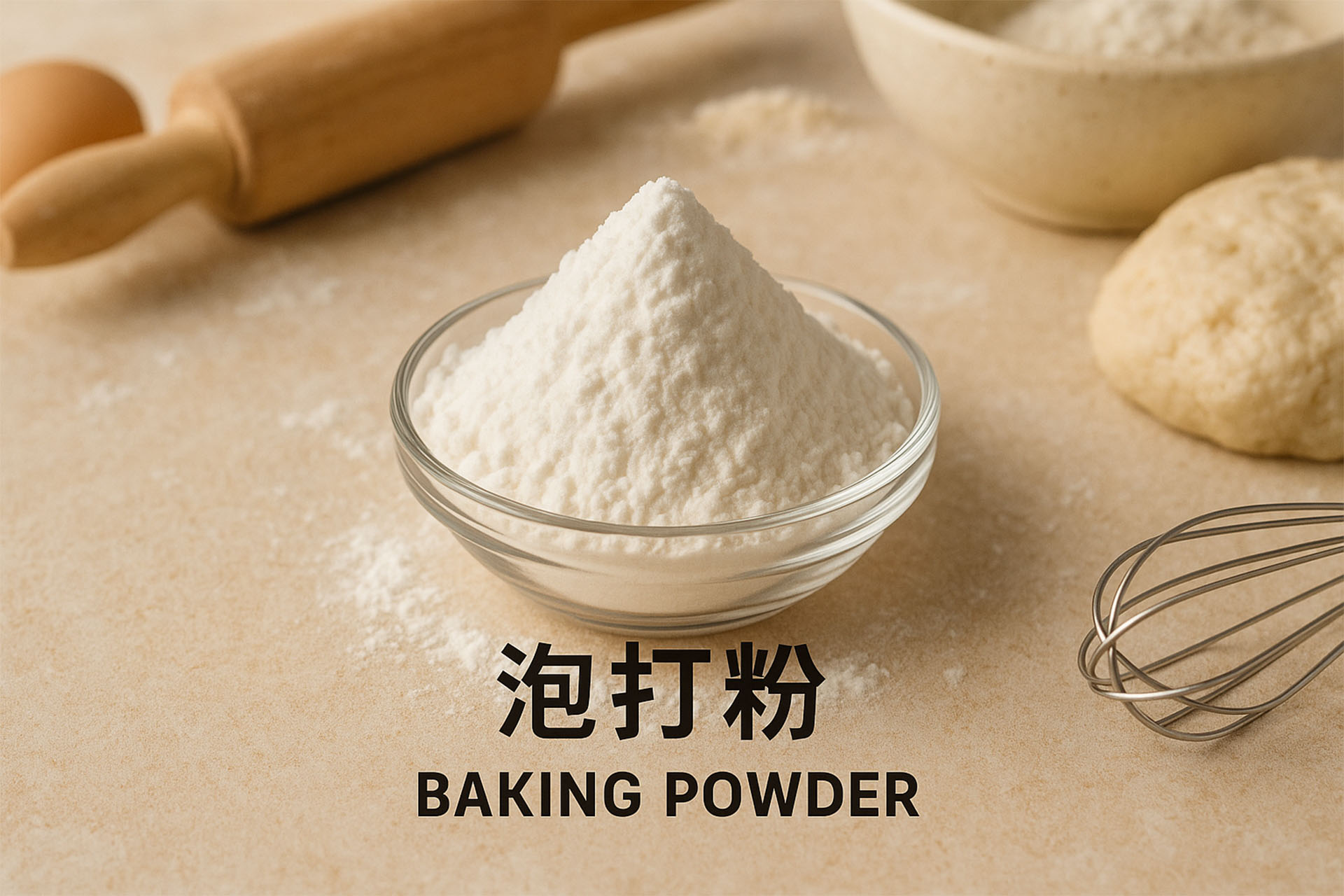
Baking powder, as a key chemical leavening agent in the baking field, achieves the fluffy effect of dough by quickly releasing carbon dioxide gas, and plays an irreplaceable role in cakes, breads, biscuits and other categories. The following is an analysis from four dimensions: mechanism of action, application scenarios, usage skills.
1. The core mechanism of baking powder
Dual reaction leavening principle
Baking powder is composed of sodium bicarbonate (baking soda), acidic salts (such as potassium hydrogen tartaric acid) and corn starch carrier. When it comes into contact with water, it immediately undergoes acid-base neutralization reaction to release a small amount of gas. When it is baked and heated, the residual ingredients accelerate the reaction to produce secondary gas release. This dual reaction characteristic enables it to adapt to both room temperature stirring requirements and high temperature expansion requirements, and is suitable for a variety of products from muffins to scones.
Synergistic effect with yeast
In mixed fermentation systems such as European bread, baking powder can complement yeast: yeast provides basic fermentation flavor, and baking powder enhances instant explosive power. For example, adding 0.5% baking powder when making German alkaline bread can increase the dough expansion rate by 15% while maintaining the crispy characteristics of the crust.
2. Precise application of baking scenarios
Cake products
Chiffon cake: Add 8-10g baking powder to every 500g low-gluten flour, and use the meringue whipping technology to expand the cake to 80% of the mold, and the texture fineness will be improved by 30%.
Pound cake: Adding 1.5% baking powder to the heavy oil formula can offset the inhibitory effect of butter on expansion, increase the volume of the finished product by 25%, and significantly improve the fracture quality.
Quick bread system
Scone: Add 6g baking powder to every 250g flour, and use the refrigerated dough technology to complete the whole process from mixing to baking within 15 minutes. The finished product is 4cm high and the layer clarity is improved by 40%.
Muffin: The batter is directly fried after standing for 5 minutes. The gas generated by the baking powder forms a honeycomb structure under the action of heat, and the fluffiness can reach 2 times that of ordinary leavened cakes.
Biscuit products
Cookies: Adding 3-5g baking powder to every 500g flour can reduce the dough ductility by 20%, increase the pattern retention of the finished product by 50%, and extend the crisp taste to 72 hours.
Soda biscuits: Adding 0.8% baking powder in conjunction with the yeast fermentation system can not only obtain the yeast flavor, but also ensure the layer stability after mechanical crisping.
3. Key technical points for use
Precise dosage control
Basic ratio: 1.5%-2.5% of the total flour is a safe range. Exceeding 3% is prone to produce metallic taste, and less than 1% will result in insufficient expansion.
Environmental correction: When the humidity is greater than 70%, the dosage needs to be reduced by 10% to prevent premature release of gas; increase the dosage by 15% in areas with an altitude of more than 1500m to compensate for the attenuation of expansion force caused by the decrease in air pressure.
Operation process optimization
Mixing process: First sieve and mix with dry powder materials 3 times, then gently stir with wet materials, and control the number of stirring times within 15 times to avoid excessive gluten formation.
Time management: The batter must be put into the oven within 20 minutes after mixing. For every 5 minutes of delay beyond this time, the expansion rate will decrease by 8%-12%.
Baking parameter adaptation
Temperature curve: Adopt a step-by-step heating method, such as preheating the cake base at 160℃ to shape it, and then raising it to 180℃ after 10 minutes to complete the expansion, which can reduce the risk of collapse.
Time control: Adjust according to the thickness of the product. A 5cm thick muffin cake takes 25-28 minutes, and a thin cookie takes 12-15 minutes. Overbaking will cause gas to escape.
As an important cornerstone of the baking industry, the application of baking powder has expanded from simple leavening function to flavor optimization, process simplification, and health upgrade. Through scientific proportioning and process optimization, its core value in improving production efficiency and ensuring product stability can be fully utilized. In the future, with the deepening of the concept of clean labeling, compounding and functionalization will become the main direction of baking powder product innovation, driving the baking industry to develop in a more efficient and healthier direction.


