
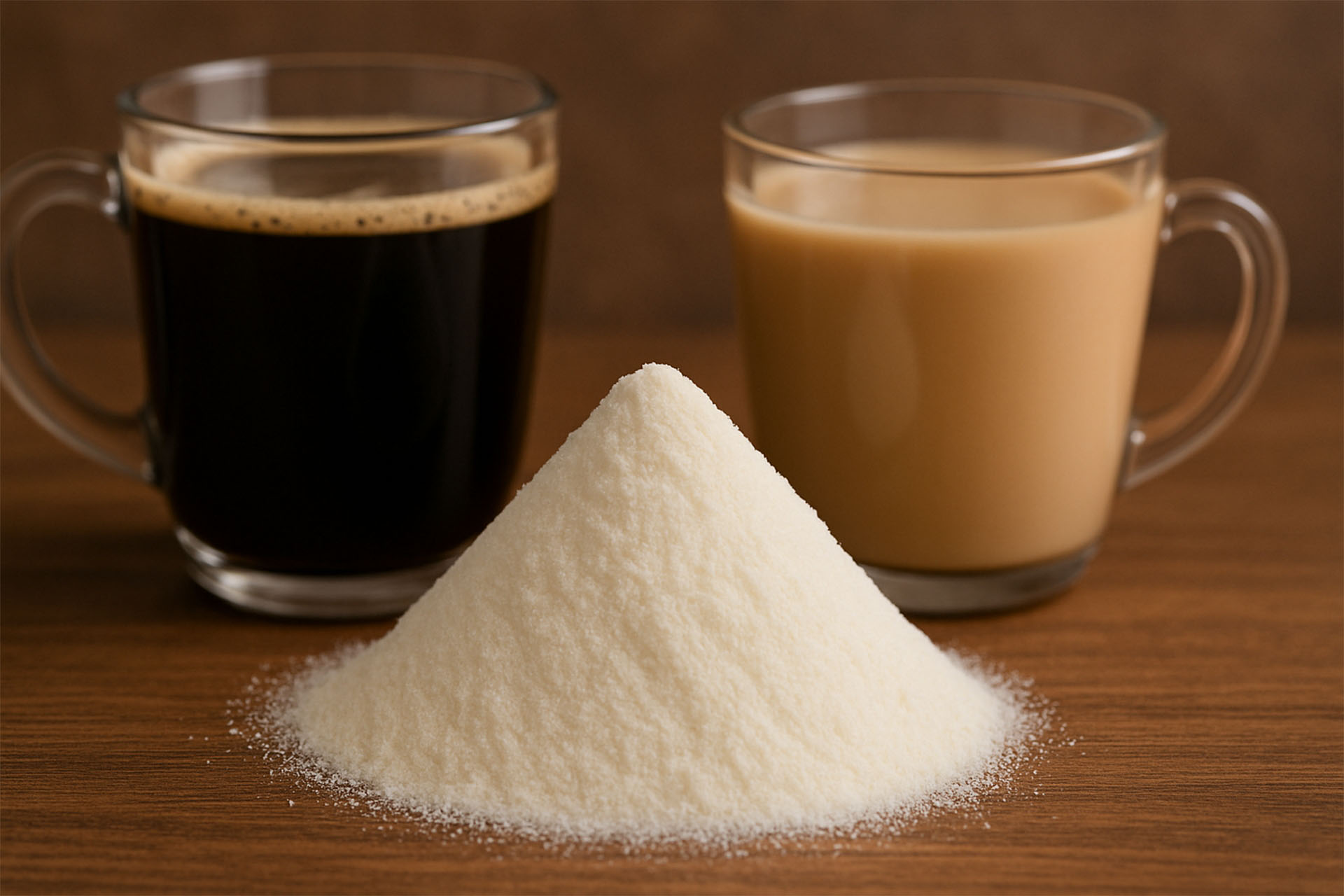
In today’s rapidly developing food and beverage industry, non-dairy creamers, as a multifunctional ingredient, are widely used in coffee, milk tea, baking and ready-to-drink beverages. Their performance directly affects the taste, stability and market acceptance of the end product. With consumers’ increasing requirements for health, nutrition and flavor, how to scientifically select suitable non-dairy creamer models has become one of the core challenges of enterprise product development.
Different application scenarios have different requirements for the functional characteristics of non-dairy creamers: coffee needs to enhance flavor and balance bitterness, milk tea pursues smooth taste and boiling resistance, baking requires high thermal stability, and cold drinks need to have excellent cold water dispersibility. In addition, factors such as protein and fat content, processing technology adaptability and regulatory compliance further increase the complexity of the selection. Scientific non-dairy creamer matching can not only optimize product quality, but also significantly shorten the R&D cycle, reduce production costs, and help companies gain an advantage in the fierce market competition. This article will systematically analyze the core elements of non-dairy selection and provide professional technical guidance for the industry.
1. Importance and Challenges of Non-Dairy Creamer Product Selection
As a functional ingredient widely used in the food industry, non-dairy creamer’s performance directly affects the taste, stability and market acceptance of the end product. In today’s highly competitive food and beverage market, choosing the right non-dairy creamer model has become one of the key factors for successful product development.
The selection of non-dairy creamer faces many challenges: first, the functional requirements of non-dairy creamer in different application scenarios vary significantly; second, consumers’ attention to health attributes makes protein and fat content an important consideration; third, the diversity of processing technology requires non-dairy creamer to have corresponding thermal stability and solubility characteristics. A systematic matching process can help customers find the best solution among many possibilities and avoid product development delays or substandard quality due to improper selection.
Professional non-dairy creamer selection can not only improve the quality of end products, but also optimize production costs. According to statistics, the correct selection of non-dairy creamer can shorten the product development cycle by 30%, reduce raw material waste by 15%, and significantly improve the competitiveness of products in the market. Therefore, establishing a scientific non-dairy creamer matching system is of great value to both suppliers and customers.
2. Customer demand analysis: the basis for non-dairy creamer selection
The first step in non-dairy creamer selection is to fully understand the specific needs of customers, which form the basis for subsequent technical matching. Customer needs can be mainly divided into three categories: nutritional requirements, physical properties requirements and terminal application scenarios.
Protein and fat content are the core nutritional indicators of non-dairy creamers. Different customers have clear requirements for these parameters based on product positioning and health demands. High-protein non-dairy creamers are suitable for sports nutrition products, while low-fat versions are aimed at the health drink market. Customers need to clearly inform their target range, such as protein content must be between 10-15%, or fat content must not exceed 30%.
The terminal application scenario determines the functional characteristics that non-dairy creamers need to have. Non-dairy creamers for coffee need to highlight the ability to enhance milk flavor and blend bitterness; special types for milk tea emphasize smooth taste and cooking resistance; baking applications require high thermal stability; and ready-to-drink cold drinks require excellent cold water dispersibility. Different PH environments (such as acidic tea drinks) also pose challenges to the stability of non-dairy creamers.
In addition, customers are also required to provide processing parameters, such as sterilization temperature, homogenization pressure, and expected storage conditions. This information helps technicians predict the performance of non-dairy creamer in actual production. For example, UHT treatment requires non-dairy creamer to have higher thermal stability, while frozen storage and transportation require antifreeze properties.
3. Technical parameter matching: from demand to solution
After obtaining clear customer requirements, technicians will start the system’s parameter matching process, which combines scientific principles and practical application experience.
Protein-fat matrix analysis is the starting point for matching. The technical team maintains a database containing various proportion combinations, which can quickly screen out candidate models that meet customer nutritional requirements. For example, when a customer needs a high-protein (>20%) and medium-fat (20-25%) product, the system will automatically exclude the basic type based on whey protein and recommend a casein compound product.
Functional test verification ensures the reliability of theoretical matching in actual applications. The laboratory will simulate the customer’s process conditions for testing: coffee application testing includes aroma evaluation, acidity buffering capacity and creaminess; tea beverage testing focuses on precipitation rate and hot and cold cycle stability; baking applications examine flavor retention at high temperatures. These tests are usually completed within 24-72 hours and provide objective performance data.
Synergistic effect evaluation considers the interaction between non-dairy creamer and other ingredients. Technicians will analyze sugars, stabilizers, acidity regulators and other ingredients in customer formulas to predict possible reactions. For example, high-calcium beverages need to avoid using non-dairy creamers containing phosphates to prevent precipitation; in high-acid environments (pH<4.0), special screening of stabilization systems is required.
4. Special matching strategies for application scenarios
Different terminal applications have unique requirements for non-dairy creamers and require targeted matching strategies.
The matching focus of non-dairy creamers for coffee is flavor enhancement and stability. Technicians will give priority to the following characteristics: good “milk release” ability, which can balance the bitterness of coffee without covering up its characteristic aroma; appropriate fat content (usually 28-35%) to provide a full taste; excellent acid resistance (stable at pH5.0-6.0). Standard espresso is used as the base for testing, and a professional tasting panel evaluates the flavor fusion.
The matching of milk tea and tea beverages focuses on taste and appearance. High-quality milk tea non-dairy creamer should provide: silky smoothness (related to monoglyceride content); excellent “cup hanging” performance; boiling resistance (long-term stability at 85-95℃). When matching, the performance at different brewing times and temperatures will be tested to ensure stability within the actual operating range. For bubble tea drinks, special attention will be paid to foaming and foam persistence.
Baking and high-temperature applications require special heat-stable non-dairy creamers. Matching criteria include: flavor stability at 160-180℃; Maillard reaction controllability; moisture retention capacity. Technicians will examine the performance of non-dairy creamer in model systems such as cookies and cakes to ensure that the ideal texture and flavor can be maintained after high-temperature processing.
The matching challenge of cold drink ready-to-drink products lies in cold water dispersibility and storage stability. Excellent cold drink non-dairy creamer should have: rapid cold water solubility (no agglomeration); long-term storage at 4-7℃ without stratification; compatibility with juice or tea polyphenols. The matching process includes cold water solubility test and accelerated stability test for up to 4 weeks.
5. Continuous optimization and technical support
Non-dairy creamer matching is not a one-time process, but a long-term cooperation for continuous optimization. Excellent technical support teams will establish customer files, track the performance of products in actual production, collect feedback and make necessary adjustments.
Production adaptability assessment is an important part of post-optimization. Technicians will analyze customers’ actual production data, such as dissolution time, homogenization efficiency, pipeline residue, etc., to fine-tune the fluidity and dispersibility of non-dairy creamer. In some cases, customers will be advised to adjust process parameters (such as water temperature or stirring speed) to achieve the best results.
Market feedback integration converts consumer preferences into product improvements. For example, if the end product receives a “lack of milk flavor” evaluation, the technical team may recommend increasing the fat content or adjusting the flavor embedding system; if there is a “thin taste” feedback, it will consider increasing the protein content or adjusting the viscosity coefficient.
Regulatory compliance review ensures that the non-dairy creamer selection meets the requirements of the target market. The technical team will continue to pay attention to changes in global food regulations, such as label declaration requirements, additive usage standards, etc., to help customers avoid compliance risks in advance. This work is particularly important when matching export products.


