
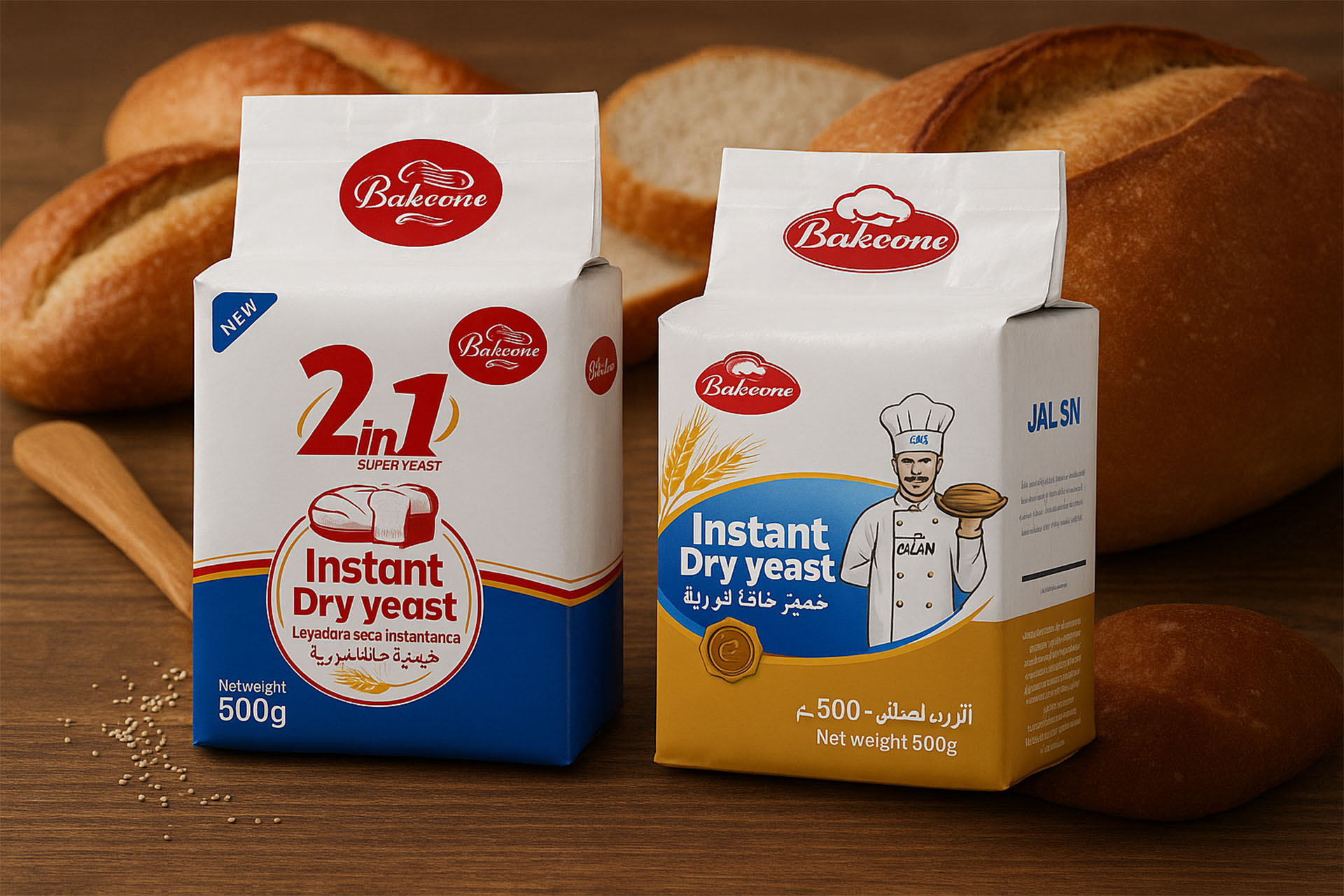
Basic classification of yeast
Based on sugar tolerance and applicable scenarios, yeast can be divided into:
Low sugar dry yeast:
Suitable for dough with a sugar content of 0-7% (such as steamed buns, dumplings, and European bread).
High sugar dry yeast:
Suitable for dough with a sugar content of 5-20% (such as sweet bread, toast, and cake).
2in1 dry yeast:
Combining low sugar + high sugar tolerance characteristics, it has a wider range of applications.
Low sugar dry yeast vs 2-in-1 dry yeast: core differences
| Comparison dimensions | Low sugar dry yeast | 2-in-1 dry yeast |
| Applicable sugar content | 0-7% sugar | Universal |
| Fermentation speed | Low-sugar dough is faster | High and low sugar are stable |
| Applicable scenarios | Steamed buns, European bread, pizza | toast, sweet bread |
| Price | Low | High |
| Storage stability | Good | Good |
1. Characteristics of low sugar dry yeast
Advantages:
Faster fermentation in a low-sugar environment (such as steamed buns, baguettes).
Low cost, suitable for daily family use.
Disadvantages:
Cannot be used for high-sugar dough (such as sweet bread, milk crisp buns), otherwise the fermentation will be slow or even fail.
2. Characteristics of 2-in-1 yeast
Advantages:
Strong versatility, can be used for both high and low sugar doughs, no need to distinguish between yeast types.
Stable fermentation, especially suitable for complex recipes with high sugar and oil content (such as Japanese raw toast).
Disadvantages:
The price is slightly higher, and the fermentation speed of low-sugar dough may be slightly slower than that of pure low sugar dry yeast.
3. How to choose? The key depends on your baking needs
1). Choose low-sugar yeast if:
Mainly make low-sugar pasta such as steamed buns, dumplings, European bread, pizza, etc.
Hope fermentation is faster and the cost is lower.
2). Choose 2-in-1 yeast if:
Often make sweet bread, toast, and Chinese snacks containing sugar and oil (such as egg yolk cakes).
Don’t want to stock up on multiple yeasts, and hope that one pack can be used universally.
High requirements for fermentation stability (such as commercial baking).
4. FAQ
Q1: Can 2-in-1 yeast completely replace low-sugar yeast?
✅ Yes, but low-sugar dough may ferment slightly slower. If you pursue efficiency (such as commercial steamed buns shop), low-sugar yeast is still the first choice.
Q2: Is high-sugar tolerant yeast = 2-in-1 yeast?
❌ No! High-sugar tolerant yeast is only suitable for high-sugar environment, while 2-in-1 yeast = high-sugar tolerant + low-sugar mixed formula, which has a wider range of applications.
Q3: Why do you need special yeast for high-sugar dough?
Excessive sugar concentration will inhibit the activity of ordinary yeast. High-sugar tolerant yeast has been specially cultivated and can maintain fermentation power under high osmotic pressure.
5. Purchase suggestions
1). Home baking
If you mainly make steamed buns and dumplings → choose low-sugar yeast (such as Angel low-sugar type).
If you often make sweet bread + Chinese pastries → choose 2-in-1 yeast
2). Commercial baking
Mass production of a single category (such as steamed buns shop) → low-sugar yeast (low cost + high efficiency).
Diversified product lines (bakery) → 2-in-1 yeast (reduce inventory types).


