
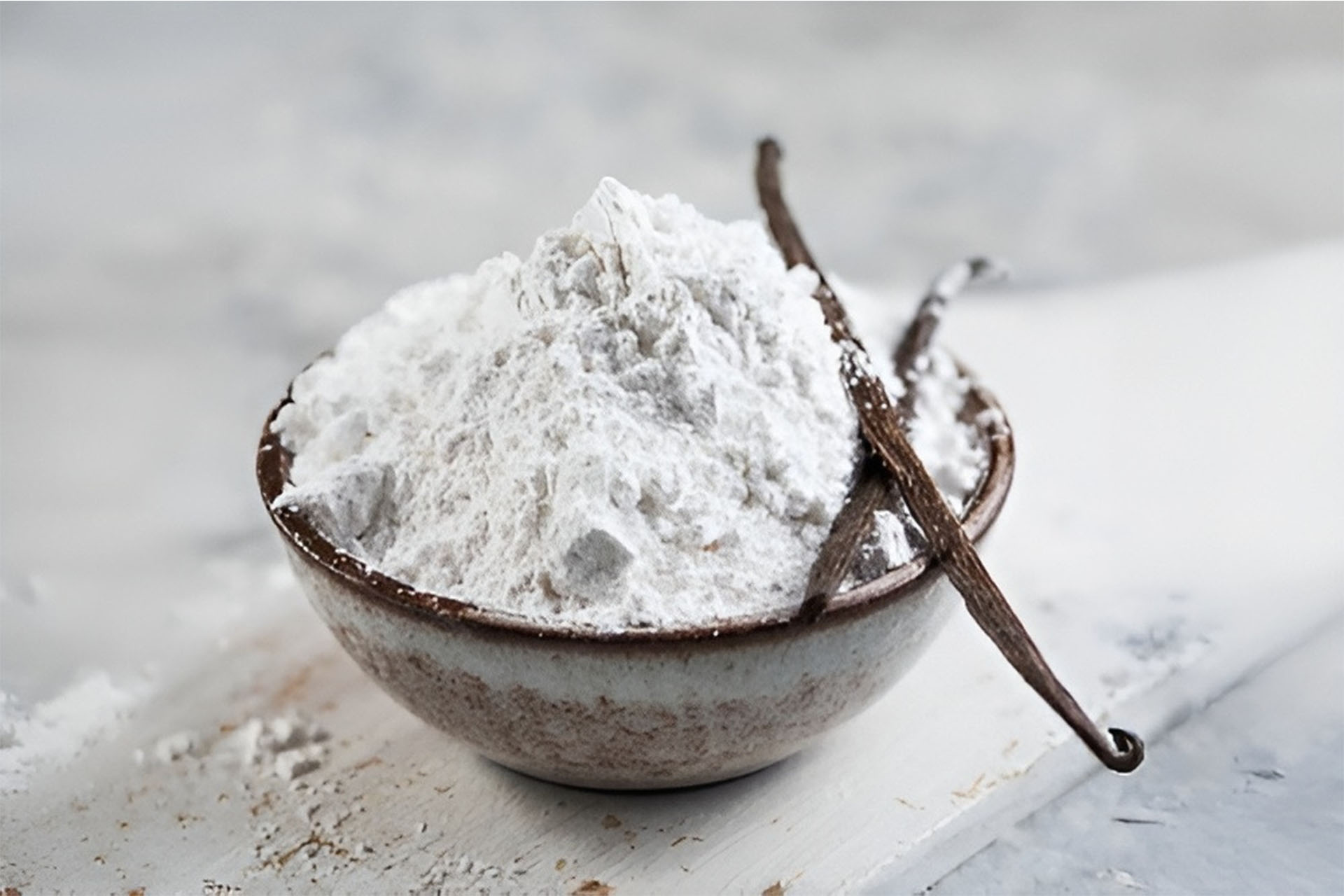
As a classic natural spice derivative, vanilla powder holds an irreplaceable position in the food industry and home baking. Compared to more common vanilla pods and extract, vanilla powder offers significant advantages in many aspects, thanks to its unique physical properties, ease of use, and flavor stability.
1. Preparation and Flavor Science of Vanilla Powder
The core ingredient of vanilla powder comes from the pods of the orchid plant Vanilla planifolia. These fermented and dried pods contain over 250 aromatic compounds, of which vanillin is the key component responsible for its characteristic flavor, accounting for approximately 2% of the dry bean weight. Traditional vanilla powder is produced by mechanically grinding dried vanilla pods into a fine powder, preserving all the aromatic compounds, seeds, and fiber components within the pods. Modern processes may add a small amount of anti-caking agents (such as silicon dioxide) to prevent moisture absorption and clumping, or blend with carriers (such as maltodextrin) to standardize the powder and ensure consistent flavor concentration.
The scientific basis for its flavor lies in the complex biochemical reactions during fermentation: enzymatic hydrolysis of glucosides releases vanillin and other byproducts, such as p-hydroxybenzaldehyde and vanillic acid, which together create the rich, warm, and sweet “vanilla” aroma. Notably, the flavor complexity of pure vanilla powder far exceeds that of artificial flavors formulated with only vanillin, as it fully retains the natural aroma spectrum of the vanilla pod.
2. Analysis of Vanilla Powder’s Core Advantages
1). Excellent Flavor Stability and Storage
As a solid powder, vanilla powder’s physical form ensures its high tolerance to environmental factors such as light, heat, and oxygen. Compared to liquid vanilla extract, vanilla powder is less volatile, and its aromatic components are locked in a solid matrix, resulting in a slow oxidation rate. Therefore, when stored in a sealed container, away from light, and at room temperature, it can be stored for long periods without deterioration or significant flavor degradation. This characteristic makes it particularly suitable for food formulations requiring long-term storage or applications subject to high-temperature processing.
2). Convenient Use and Accurate Metering
The powdered form allows vanilla powder to be quickly and evenly mixed with other powdered ingredients (such as flour, powdered sugar, and cocoa powder). This eliminates the need for splitting and scraping the seeds, as with vanilla pods, and avoids the potential variations in batter consistency caused by liquid vanilla extract. For industrial production or rigorous baking experiments requiring precise proportions, an electronic balance allows for accurate milligram-level metering of vanilla powder, ensuring consistent and reproducible product flavor.
3). Wide Application and Compatibility
Vanilla powder is virtually unaffected by the compatibility of food systems. Whether it’s aqueous (e.g., beverages, ice cream), oil-based (e.g., butter cookies, chocolate), or flour-based (e.g., cakes, bread), vanilla powder disperses evenly without causing oil-water separation or localized over-concentration. It retains most of its flavor even when baked at high temperatures (typically above 180°C) because many key aromatic compounds are thermally stable, making it an excellent choice for products subjected to high temperatures, such as biscuits and cakes.
4). Providing a Unique Visual and Textural Experience
High-quality vanilla powder often contains visible dark vanilla seed particles. These seeds create a natural “black speck” in the product, serving as a visual indicator of the use of authentic vanilla ingredients and enhancing the product’s natural, premium feel. Furthermore, vanilla powder contains trace amounts of fiber, which may slightly affect texture in certain applications, but this is generally not considered a primary function.
5). Affordability and Controllability of Concentration
While premium pure vanilla powder may be more expensive per unit, its flavor concentration is typically much higher than liquid vanilla extract and is free of dilution with solvents such as alcohol or glycerin. Users can flexibly adjust the dosage based on the desired flavor intensity, achieving a range from a subtle touch to a full-bodied, rich flavor. For products with extremely demanding flavor requirements, a small amount of high-quality vanilla powder can achieve the desired effect, potentially offering a cost-effective advantage.
3. Comparison of Vanilla Powder with Other Vanilla Forms
Compared to vanilla pods: Vanilla pods offer the richest, most complete, fresh aroma, but they are expensive, time-consuming to process, and can lose their oils and become hardened if not properly stored. Vanilla powder offers advantages in convenience, stability, and cost control. While it may lack the freshness of its aroma, it perfectly replicates the core flavor profile.
Compared to liquid vanilla extract: Commercial vanilla extracts often use alcohol or propylene glycol as solvents. The volatility of these solvents can lead to a loss of some top notes and affect the texture of alcohol-sensitive recipes (such as certain candies). Vanilla powder eliminates these concerns, offering a more immediate and long-lasting flavor. However, in cold beverages where instant, even dissolution is required, liquid vanilla extract may mix more quickly.
Compared to vanillin alone: Synthetic vanillin provides only a single sweet note, lacking the complex, rounded creaminess, smokiness, and fruity undertones of natural vanilla. Vanilla powder retains this natural complexity, giving the final product a deeper and more natural flavor.


