
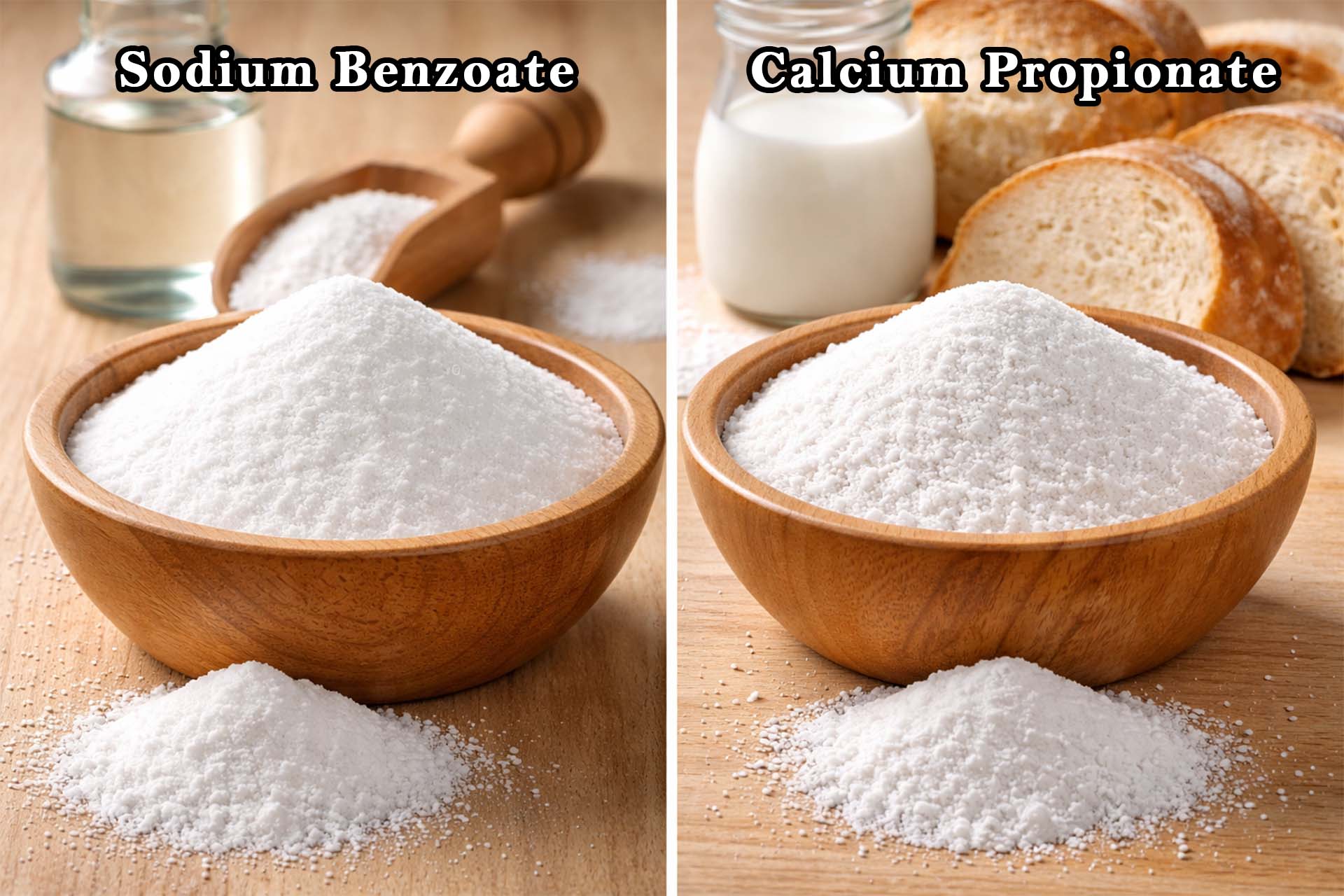
In the complex landscape of food preservation, the choice of a preservative is rarely arbitrary; it is a calculated decision based on the chemical environment of the food matrix and the specific microbial threats at hand. Sodium benzoate and calcium propionate represent two of the most critical pillars in modern food safety, yet they operate through distinct biological defense strategies. While one thrives in the high-acidity environments of beverages and condiments, the other serves as the essential guardian of the global bakery and dairy industries.
By understanding the relationship between pH levels, metabolic pathways, and regulatory safety margins, food scientists and manufacturers can deploy these tools with precision. This article provides a comprehensive technical analysis of their unique preservative mechanisms, their established safety profiles under global standards like JECFA and GB 2760, and the strategic considerations that dictate their use in the global food supply chain.
I. Chemical Nature and Preservative Mechanism: Two Different Defense Strategies
Sodium benzoate and calcium propionate, although both belonging to the preservative camp, have distinct chemical natures and modes of action.
Sodium benzoate, the sodium salt of benzoic acid, typically appears as white granules or crystalline powder and is readily soluble in water. Its core preservative function lies in the benzoic acid molecule. In an acidic environment (pH below 4.5), sodium benzoate transforms into benzoic acid, which has stronger antibacterial activity. Benzoic acid molecules can non-selectively penetrate the cell membranes of microorganisms, entering the cell interior, interfering with cell membrane permeability, and inhibiting the activity of microbial cellular respiratory enzymes (such as succinate dehydrogenase), especially showing significant inhibitory effects on yeasts, molds, and some bacteria. Therefore, it is widely used in acidic foods such as carbonated beverages, fruit juices, soy sauce, vinegar, and jams, serving as their preferred preservative.
In contrast, calcium propionate, the calcium salt of propionic acid, is also a white crystalline powder, but its properties differ significantly from sodium benzoate. It exerts its effect both in vivo and in vitro by dissociating and releasing propionic acid. Propionic acid is a normal metabolic product in the human intestine. Its preservative mechanism primarily involves undissociated propionic acid molecules entering microbial cells, where they decompose to produce acidic substances, lowering the intracellular pH and potentially inhibiting enzyme activity (such as methylmalonyl-CoA mutase). This effectively inhibits the proliferation of molds and aerobic Bacillus, and is particularly effective against Bacillus subtilis, which causes bread and other foods to become sticky. Therefore, calcium propionate is an indispensable antifungal agent in neutral to slightly alkaline foods, especially baked goods, such as bread, pastries, cheese, and soy products.
In short, sodium benzoate is an expert in the “acidic battlefield,” while calcium propionate is a guardian of the “staple food battlefield.” Both, with their different chemical weapons, construct effective microbial barriers within their respective pH ranges.
II. Safety Spectrum and Regulatory Standards: Science-Based Risk Management
The public has always maintained a high level of concern regarding the safety of food additives. For sodium benzoate and calcium propionate, both international and domestic authoritative organizations have established strict safety standards based on long-term toxicological studies and risk assessments.
The safety of sodium benzoate has undergone more extensive public discussion. In the human body, it mainly combines with glycine to form hippuric acid, which is excreted in urine; some can also be detoxified by combining with glucuronic acid. The Joint FAO/WHO Expert Committee on Food Additives (JECFA) under the World Health Organization (WHO) and the Food and Agriculture Organization of the United Nations (FAO) has established an acceptable daily intake (ADI) of 0-5 mg/kg body weight for benzoic acid and its sodium salt. This means that for a 60 kg adult, a daily intake not exceeding 300 mg is considered safe for life. China’s National Food Safety Standard for the Use of Food Additives (GB 2760-2014) clearly and meticulously regulates its scope of use and maximum usage, for example, the maximum usage in carbonated beverages is 0.2 g/kg. It is worth noting that under specific conditions (such as the presence of vitamin C), sodium benzoate may generate trace amounts of benzene with an extremely low probability. However, this reaction can be effectively controlled under regulated production and storage conditions (such as protection from light and high temperatures), and the amount generated is far below the drinking water standard limit, posing an extremely low risk.
Calcium propionate is generally considered safer and more tolerable because its metabolic pathway is closer to that of the human body (propionic acid is an intermediate product of fatty acid β-oxidation). JECFA sets its ADI value as “no limit,” meaning that its safety is extremely high under normal usage. Chinese national standards also clearly stipulate its usage in bread, pastries, and soy products (usually below 2.5 grams/kg). It is not only an effective preservative but also a calcium fortifier, providing approximately 21% of the elemental calcium.
The safety of both preservatives is established based on the principle of “dosage determines toxicity.” The maximum usage limits stipulated in regulations already provide a safety margin of hundreds of times. Under the premise of legal and compliant use, the amount ingested by consumers through daily diet is extremely far from the dose that could pose a health risk.
III. Application Differentiation and Future Trends: Precise Selection to Meet Demands
In actual production, the choice between sodium benzoate and calcium propionate is not arbitrary, but rather based on a comprehensive consideration of food characteristics, process requirements, preservation objectives, and cost-effectiveness.
Sodium benzoate, with its high efficiency and economy under acidic conditions, firmly holds a dominant position as a preservative in beverages (especially carbonated drinks and fruit juices), condiments (sauces, vinegar), and acidic dairy products. Its good water solubility means it hardly affects the original flavor of the food.
Calcium propionate, due to its anti-mold effect and weak inhibition of yeast fermentation (crucial for fermented foods like bread), has become the preferred choice in baked goods (bread, cakes), cheese, Chinese and Western pastries, soy sauce, and soy products. It not only effectively prevents mold and mycelial growth but also has a certain calcium fortification effect and, unlike sodium benzoate, does not have strict pH requirements.


